Art Statement
In her work, she also seeks to reveal subtle and often transcendent themes — not through abstraction, as is often the case in contemporary art, but through believable reality. Anna holds a personal conception of God, and in her art she follows what she believes in, searching for truth by giving it definite form. Yet she does not bring it down to a mundane level, but translates it into the language of symbolism and allegory — in the same way that lovers write poetry, speaking indirectly so that the meaning can be read only between the lines. Of course, this can be understood only by someone who has lived through a similar experience. But is love not the ultimate truth — the one worth living for, searching for, and bringing into art?
For this reason, even when addressing transcendent subjects, Anna avoids religious attributes and uses symbolism carefully — only to the extent necessary to hint at the theme. After all, speaking about love too literally can frighten away this intimate feeling. It is much better not to tell, but to show, as they say in cinema. Here, outstanding examples for Anna are Tarkovsky, Norshteyn, as well as the Japanese animators Miyazaki and Shinkai — authors who succeeded in conveying non-trivial themes to a wide audience through visual language.
Speaking of directing, it is also worth turning to Stanislavski, whose method Anna regularly applies in her own approach, questioning her work and asking herself: “Do I believe in what is happening on the canvas?” After all, when working with subjects born in the imagination, it is easy to become carried away and begin justifying underdeveloped ideas as an authorial interpretation. But what is a sincere reimagining of a studied theme, and what is cheap speculation? The line is thin, and each person determines this responsibility for themselves. With a background in psychology and research into the nature of creative thinking, Anna believes that it is very important to walk hand in hand with both intuitive, irrational feeling and logical analysis. Empathy helps her absorb subtle experiences, while structural thinking makes it possible to gather them into a unified composition.
This is a large and long-term practice that requires full immersion and has therefore become her full-time work. Such a process gives birth not only to one large painting, but also to many accompanying works — from landscapes to individual portraits of the characters who appear in the composition. Therefore, even her everyday subjects are often shaped by the theme in which she is immersed while creating a large-scale work. She enjoys working with actors, developing design, and selecting locations for her canvases, acting, in a certain sense, as a director.
Through her own example, Anna shows that the path of a contemporary artist is all-encompassing. It can include many professions, encounters with people, and opportunities to bring one’s artistic language into new forms as never before. Yet alongside this, it also implies inner discipline, since the author inevitably projects their consciousness onto the canvas, and this invisible imprint can at times have a strong influence on the viewer’s perception. For this reason, Anna pays close attention to the state of mind she is in when she paints, and strives to work only with themes that elevate consciousness, even when the subjects are dramatic. Her favourite time of day is sunrise, when the sun rises over the field and, with its rays, dissolves the mist, presenting everything in its true light. She strives toward the light and tries to capture it in her works in such a way that they invite the viewer into a space where they may find peace. Her works are long-term projects, and they reveal themselves through contemplation. How deeply the viewer wishes to enter into them remains an open ending — as in a film, which each person defines for themselves.


Anna Petrova creates large-scale oil paintings, taking inspiration from the heritage of different traditions. At present, she is more focused on the culture of the East, visually adapting it for a Western viewer. This comes naturally to her because she grew up in a European cultural environment, where her artistic taste was shaped by the ideals of the Greco-Roman tradition. At the same time, since her teenage years, she has looked to Eastern philosophy for answers to the questions that mattered most to her.
Since her education has unfolded in several stages — from architecture to painting — this is also reflected in her work: in form, her paintings can be associated with realist painting, while in content they remain conceptual. Several artistic movements have had a strong influence on her — first of all, the Wanderers, for whom landscape was not only a materially truthful and beautiful depiction of nature, but also an emotional expression of the state of the spirit. She also finds a strong resonance in the British Pre-Raphaelite Brotherhood, whose artists wanted to move beyond academic rules and give new life to ancient mythology and medieval subjects while being inspired by the sincerity of Botticelli and other artists of the Early Renaissance.


Artist's note
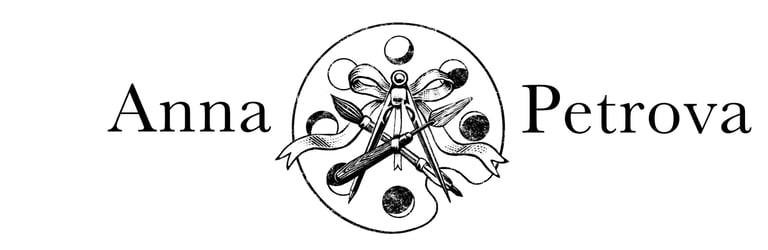
The brush symbolizes my profession as a painter, as well as gentleness in craftsmanship — the lightness of oil painting and the empathy an artist must have toward the subject.
The drawing compass symbolizes precision. It reflects my architectural education, brings a sense of order to the composition, and represents the discipline required of a professional artist.
The palette knife symbolizes purity — both in the creative process and in the clarity of consciousness. An artist merely allows an image to pass through them, and the clearer their mind, the more profoundly the work can resonate with the viewer.
The ribbon that unites all the elements represents the continuity of the generations before me. Their lives and work form the foundation that allows me to create today.
The palette symbolizes modernity. Its paint wells are intentionally filled to resemble the phases of the moon, representing the passage of time and emphasizing the importance of an artist remaining in rhythm with the cycle of their era.


My great-grandfather created this logo using the symbolism of the Andreev family, inheriting the tradition of stone engraving from the previous generation. After getting married, following Slavic tradition, I took my husband’s surname, bringing together our family legacies. At the same time, my patronymic still bears the name of my forefather.
Having studied architecture and later continued my craft through painting, I decided to create a new interpretation of this family symbol, expressing the values that shape my own artistic practice.
Here is the symbolism behind it: